
作者:百年不渡 分类:未来幻想 点击:670次 下载:27239次 大小:70M 日期:2026-08-26
飞龙在天
受台风“梅花”影响 杭州转移407725人 大中型水库均未超汛限水位_我的网站

一 |
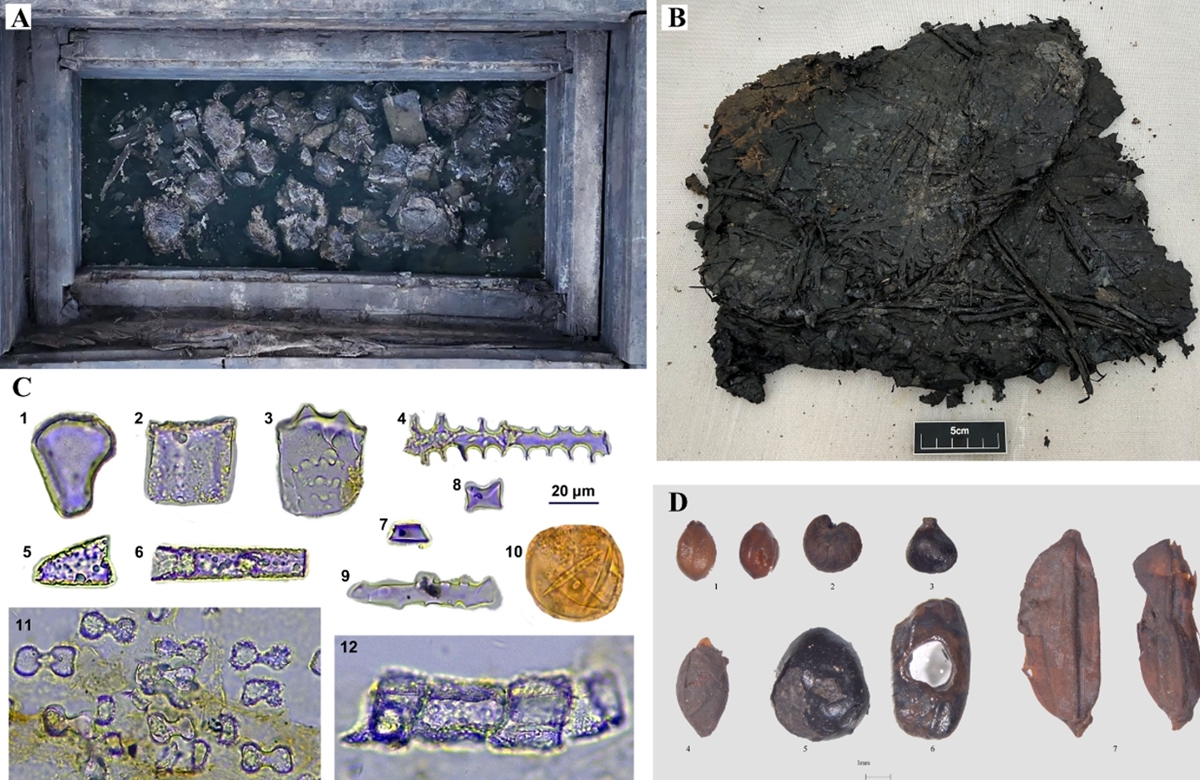
In March 2024, archaeologists from the National Center for Archaeology excavated a large number of well-preserved, waterlogged plant bundles from the tomb's outer coffin chamber. On-site, the plant bundles could be seen tightly wrapped in broad leaves and tied with plant-fiber cords.
A team of researchers led by the National Center for Archaeology, IVPP, and the Chinese Academy of Social Sciences examined 12 of the bundles and found that the wrapping leaves came from oak trees, while the cords were made from grasses.
The bundles mainly contained rice, broomcorn millet, foxtail millet, and cereal seeds, most of which were still in their husks and mixed with inflorescence material. Small amounts of peppercorn, mallow and rice-field weed seeds were also found.
The fact that the bundles were found in a tomb and mainly contained grains still in their husks suggests they were not everyday food, but offerings intended for funerary rituals. "This might reflect a Warring States-era belief that grains served as wealth for the dead in the underworld," Ge Yong, an associate researcher at the IVPP and the study's corresponding author, told the Global Times.
A Qin Dynasty (221BC-206BC) text describes a belief that "soybeans were gold and millet was money" for the dead, indicating that grains held symbolic significance in funerary culture. "The bundles therefore appear to have been ritual offerings prepared for the deceased," Ge said, "not food for the living."
The physical structure of the bundles also resembles that of zongzi, with grains wrapped in leaves and tightly secured with plant-fiber cords. "Similar practices of wrapping grains for burial have also been found elsewhere within the Chu cultural sphere," Ge said, "such as at the Chengyangcheng Site."
At the Chengyangcheng archaeological site in Henan Province, rice and broomcorn millet were also discovered wrapped in oak leaves. "An interesting fact is that we can still find zongzi wrapped with the same oak leaves now in regions related to the Chu cultural sphere."
"The findings suggest that wrapping grains as funerary offerings was a relatively common practice in the Chu state during the Warring States period," Ge said. "And this practice may have been an early form of the zongzi later associated with the legend of Qu Yuan."
These plant bundles share a structure similar to that of modern zongzi and to those described in legends and folklore. This might reflect how, through cultural exchange and heritage, these 2,200-year-old plant bundles likely evolved over centuries, shifting from sacrificial offerings to food, said Ge.
As diverse regional populations adapted the practice, it eventually transformed into the well-known Dragon Boat Festival tradition of eating zongzi. Thus, this structural resemblance might suggest a potential historical lineage; however, experts stressed that the Wuwangdun bundles should not simply be labelled as ancient zongzi.
"We can't define these plant bundles as the earliest zongzi, but rather, we can confirm that by 2,200 years ago at the latest, the Chu region had established a tradition of using this specific form of plant bundles for funeral rites. And this tradition could be a possible origin or precursor of the well-known zongzi," said Ge.
He added that the discovery provides critical physical evidence to explore the origins of zongzi and its cultural heritage.
。
受台风“梅花”影响,杭州多地迎来大到暴雨,局地大暴雨天气。从昨晚开始,各地积极组织群众转移,截至目前,杭州全市已转移407725人,其中在建工地387750人、地质灾害817人、小流域山洪3142人、危房352人、老旧房393人、其他风险点621人、在建交通工程12055人、扩面转移2595人。杭州全市公路营运正常,渡口、码头和运输船舶均维持停运、停装卸和停航。维持停运线路558条、班车1147辆、农村客运车辆444辆,停运包车1882辆、危货1406辆。投入人员1980人次、应急抢险设备216(辆)台。全市111个在建工程全部停工。目前,杭州全市主要江河控制站均在警戒水位以下,大中型水库均未超汛限水位。记者从杭州市气象台了解到,受台风梅花影响,今天晚上到明天早晨,杭州东部区县、临安北部和余杭西北部山区有大雨到暴雨,局部大暴雨。今天傍晚到明天上午最大偏北风7~9级,部分高山区和钱塘江等江湖水面9~10级个别11级,请各有关方面注意。(总台记者 于晨)
。
二 |
Current article:http://iehw830.minshixuanhabing.bond/btfw7sm/fsk7.html
Published on:06:40:13


飞龙在天TXT下载声明:
1 我的网站免费提供的飞龙在天,均由网友上传,供下载测试之用,不作商业用途,下载后请二十四小时后删除!
2 我们根据txt小说全文所整理出飞龙在天txt电子书全集免费下载,由程序自动生成飞龙在天txt下载文件。
3 书友所发表的txt小说飞龙在天的相关评论,并不代表本站赞同飞龙在天txt下载或者支持飞龙在天的读者观点。
4 如果发现小说《飞龙在天txt全集》无法下载未及时更新请联系我们。如果您喜欢飞龙在天txt电子书,请支持作者到书店购买正版图书。感谢您的合作与支持。
5 好看的小说飞龙在天是作者"百年不渡"的最新力作,飞龙在天电子书由网友发布;小说飞龙在天版权属于作者所有,如果侵犯您的利益,请通知我们。